
How Motorized Blinds Work: A Homeowner's Guide
- WINDOWCOVERINGWIZARD
- 1 day ago
- 8 min read

Motorized blinds are automated window treatments with a compact electric motor built into the headrail or roller tube, giving you hands-free control over light and privacy. The motor raises, lowers, or tilts the blinds on command from a remote, wall switch, smartphone app, or voice assistant like Amazon Alexa or Google Home. Power comes from batteries, hardwired electrical connections, or solar panels. Systems from brands like Somfy and Hunter Douglas have made this technology reliable and accessible for both homeowners and renters. Understanding how motorized blinds work helps you choose the right setup, avoid costly mistakes, and get the most from your investment.
How do motorized blinds work inside?
A small electric motor sits hidden inside the headrail or roller tube of the blind. When you send a command, that motor rotates an internal shaft or gear system to move the fabric or slats precisely and quietly, typically operating under 40 dBA. That is quieter than a normal conversation, so you will not notice it running in the background.
The mechanism differs slightly depending on the blind type. Roller shades and cellular shades use a single tube that winds or unwinds fabric. Venetian blinds and horizontal slat blinds use a separate tilt mechanism, so the motor can both raise the blind and rotate the slats to control the angle of incoming light. This two-function capability is what makes slatted motorized blinds more mechanically complex than shades.
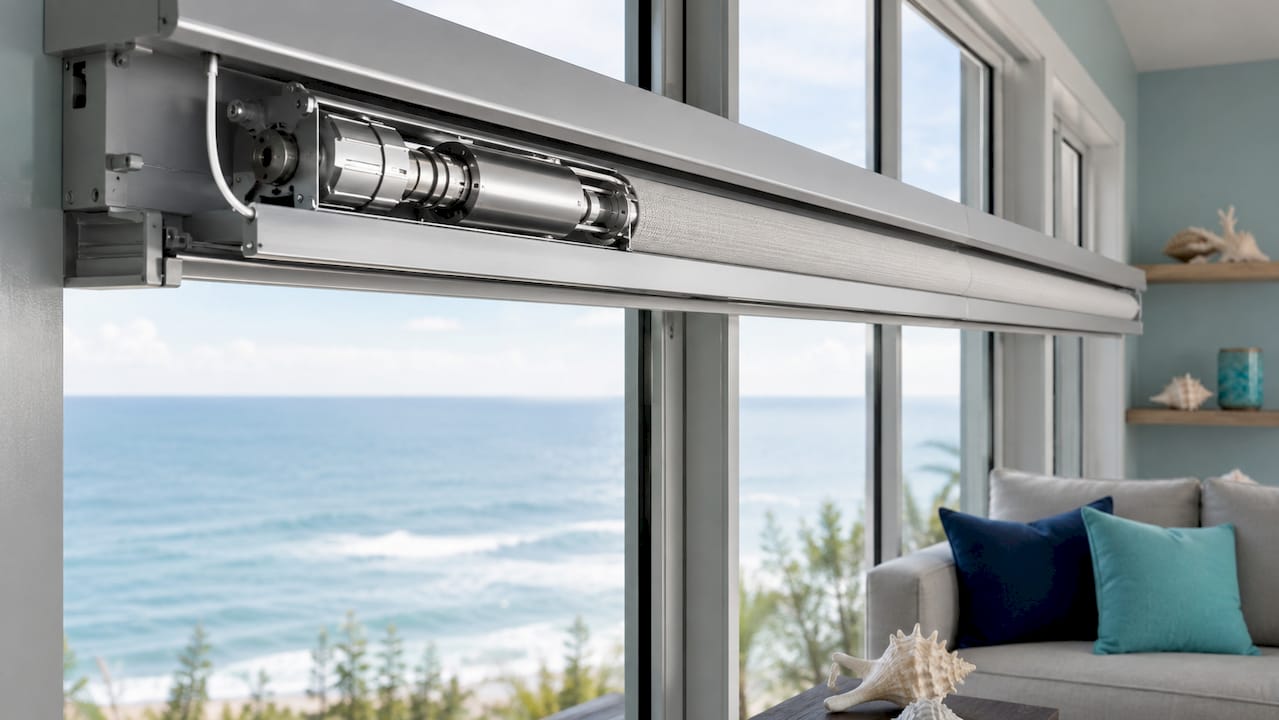
One of the most important technical details is the limit setting. Every motor is programmed with upper and lower stop points. These limits tell the motor exactly where to stop when the blind is fully open or fully closed. Incorrect limit settings cause the motor to strain against a hard stop repeatedly, which is the leading cause of premature motor failure. Getting this right during setup is not optional.
During the programming process, you will notice the blind make a quick up-and-down movement called a jog. The motor’s jog motion is a normal confirmation signal that the motor has accepted the command and paired successfully with the remote. Many homeowners mistake it for a malfunction. It is not. Interrupting the jog step causes setup failure, so let it complete fully.
Pro Tip: Never force a blind to move manually after the motor is installed. Even small amounts of manual force can throw off the limit settings and stress the motor’s internal gears.
What power and control options are available?
Comparing power sources
Motorized blinds run on one of three power sources, each with real trade-offs.
Power Type | Best For | Key Advantage | Key Drawback |
Battery-powered | Renters, retrofit installs | No wiring needed, easy install | Batteries need replacement every 6–12 months |
Hardwired | New builds, permanent installs | Continuous power, no maintenance | Requires licensed electrician |
Solar-powered | South-facing, sunny rooms | Near-zero battery maintenance | Needs consistent direct sunlight |
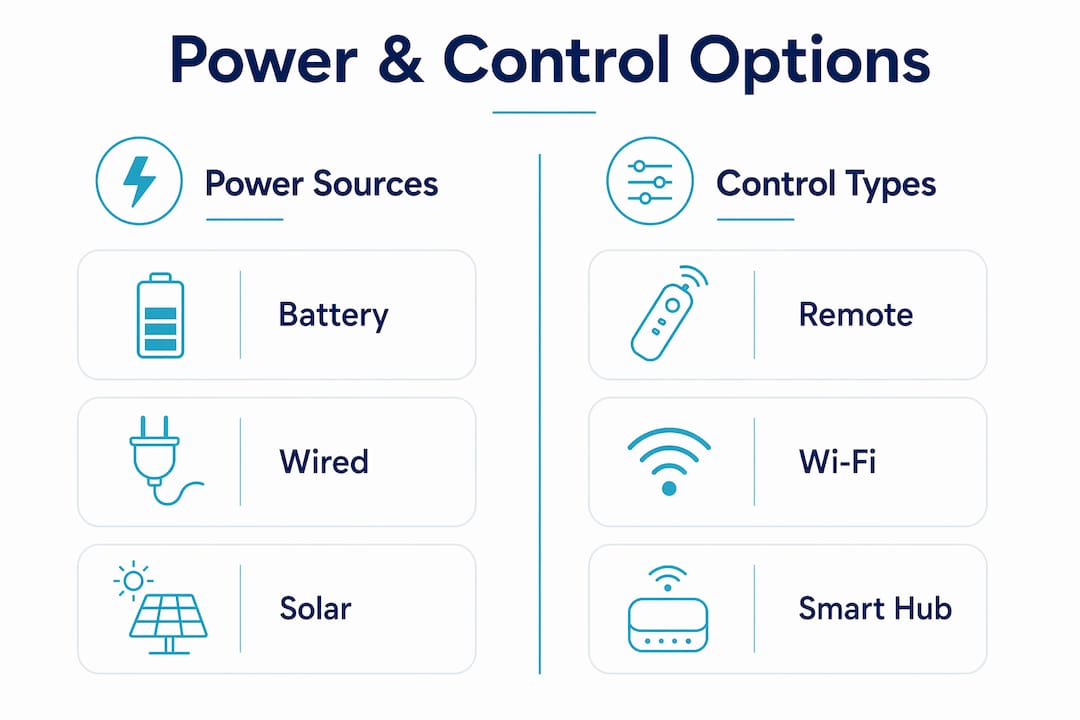
Battery-powered blinds are the easiest option for renters because no electrical wiring is required. Modern lithium batteries last 6–12 months per charge cycle, and some systems include solar trickle-charging strips that can virtually eliminate manual recharging in sunny conditions. Hardwired blinds deliver continuous power with zero battery management, but they require an electrician and are best planned during a renovation or new build. Solar-powered blinds work best on south-facing windows with consistent sun exposure.
Control technologies explained
Control options range from simple to fully integrated:
RF remote controls operate on radio frequency and work without Wi-Fi or internet. They are reliable and simple, but offer no scheduling or automation.
Bluetooth connects directly to your phone without a hub, though range is limited to roughly 30 feet.
Wi-Fi enables full app control, scheduling, and voice commands through Alexa, Google Home, or Apple HomeKit from anywhere in the world.
Matter protocol is the newest standard, introduced broadly in 2026. It allows one blind to work across multiple smart home ecosystems simultaneously without choosing a single platform.
Pro Tip: If you already use Alexa or Google Home for other devices, choose a Wi-Fi or Matter-enabled motor from the start. Upgrading the control system later often means replacing the motor entirely.
Retrofit motors are also worth knowing about. Retrofit options like SwitchBot and SmartWings attach to existing roller or Roman shades, motorizing them quickly without replacing the entire window treatment. The key compatibility check is fabric weight and roller diameter. Most standard rollers qualify, but heavy blackout fabrics sometimes exceed the motor’s torque rating.
How are motorized blinds installed?
Installation follows a logical sequence, but the details matter more than most buyers expect.
Measure and order. Confirm inside or outside mount dimensions before ordering. Motorized blinds are custom-cut, so measurement errors are expensive to fix.
Mount the brackets. Attach the headrail brackets to the window frame or wall. Use a level. Even a small tilt creates uneven fabric tension over time.
Connect the power source. For battery models, insert the battery pack into the headrail. For hardwired models, connect to the in-wall wiring before mounting the headrail.
Hang the blind. Clip the headrail into the mounted brackets and confirm it sits flush and level.
Program the limits. Use the included remote or app to set the upper and lower stop points. This step determines how far the blind travels in each direction.
Pair the remote or app. Follow the manufacturer’s pairing sequence. Watch for the jog confirmation before moving on.
Test all functions. Run the blind through a full open-and-close cycle several times. Check that it stops cleanly at both limits without hesitation or grinding.
The biggest decision in installation is motor placement. Concealed motors inside headrails are primarily an aesthetic choice. Surface-mounted motors deliver identical performance and are significantly easier to install in finished rooms without opening walls. For most retrofit situations, surface-mounted is the smarter call.
Professional installation adds real value beyond just hanging the blind. Professional installers ensure precise calibration across multiple windows, which keeps the appearance uniform and protects motor longevity. For a single window, DIY is manageable. For a whole house, professional setup pays for itself in avoided repairs. You can also review window installation best practices to understand what proper mounting and sealing look like before your installer arrives.
What benefits do motorized blinds offer?
The practical advantages go well beyond convenience, though convenience is real and significant.
Effortless daily use. One button or voice command controls every blind in a room simultaneously. This matters most for hard-to-reach windows above staircases or in vaulted ceilings.
Energy savings. Automated schedules close blinds during peak sun hours to reduce heat gain and glare, cutting cooling costs without any manual effort. Pairing motorized blinds with energy-efficient cellular shades amplifies this effect significantly.
Home security. Scheduling blinds to open and close on a timer while you travel creates the appearance of occupancy, which deters opportunistic break-ins.
Fabric protection. Consistent, motorized movement prevents the uneven wear and fabric stress that comes from yanking cords or chains repeatedly.
Increased home value. Motorized window coverings are a recognized upgrade in real estate listings, particularly in higher-end markets.
“The biggest surprise for most of our clients is how much they use the scheduling feature. They set it once and forget it. The blinds just work.”
Battery life is a common concern. Modern lithium batteries last 6–12 months, and most systems send a low-battery alert through the app before power runs out. Solar charging strips extend that interval further. The ongoing cost is minimal compared to the daily convenience gained. You can explore more about the value of motorized shades to see how the numbers stack up over time.
How do motorized blinds fit into a smart home?
Smart home integration is where motorized blinds move from convenient to genuinely useful. The key distinction is this: motorized systems operate without internet, while smart systems connect to home ecosystems for scheduling, automation, and voice control. You can have one without the other.
For full smart home functionality, Wi-Fi or Matter-enabled motors connect to platforms including:
Amazon Alexa for voice commands and Routines
Google Home for scheduling and device grouping
Apple HomeKit for iOS-native control and Siri integration
Samsung SmartThings for broader device automation
The Matter protocol introduced in 2026 eliminates the old problem of ecosystem lock-in. A Matter-certified blind works with Alexa, Google Home, Apple HomeKit, and Samsung SmartThings simultaneously. You no longer have to choose one platform and commit to it permanently.
Scene setting is one of the most practical features. You can create a “Movie Mode” that closes all blinds in the living room with one command, or a “Morning” scene that opens every blind in the house at 7:00 a.m. automatically. Solar charging technology is also improving rapidly, with newer systems using thin photovoltaic strips along the headrail to maintain battery charge year-round in most climates.
Key takeaways
Motorized blinds work by converting electrical energy into precise mechanical motion through a compact motor, controlled by remotes, apps, or voice commands, with power from batteries, hardwiring, or solar panels.
Point | Details |
Motor location matters | The motor sits inside the headrail or roller tube and operates under 40 dBA for quiet daily use. |
Limit settings are critical | Incorrect stop points strain the motor repeatedly and are the leading cause of motor failure. |
Power source fits your situation | Battery suits renters; hardwired suits permanent installs; solar suits sunny south-facing windows. |
Matter protocol removes lock-in | Matter-certified blinds work with Alexa, Google Home, Apple HomeKit, and SmartThings simultaneously. |
Professional calibration pays off | Expert setup across multiple windows protects motor longevity and keeps appearance uniform. |
What i’ve learned after installing hundreds of motorized blinds
The question I get most often is: “Should I go battery or hardwired?” My honest answer is that it depends on one thing. If you are renting or renovating in phases, go battery. If you are building new or doing a full renovation, hardwire every motor. Running low-voltage wiring during construction costs almost nothing. Retrofitting it later costs a lot.
The second thing I have seen trip people up is skipping professional limit calibration to save money. A motor that hits a hard stop 10 times a day will fail within a year. A properly calibrated motor runs for a decade. The calibration service costs a fraction of a motor replacement.
On control systems, my recommendation is simple. If you already use a smart home platform, buy a motor that supports Matter. If you do not use any smart home devices, an RF remote is perfectly reliable and far simpler to operate. Do not buy Wi-Fi capability you will never use.
One aesthetic note: concealed motors look cleaner, but surface-mounted motors are easier to service. For a rental or a room you might reconfigure, surface-mounted is the smarter call. For a permanent master bedroom installation where appearance matters most, go concealed.
The biggest mistake I see buyers make is choosing a motor based on price alone without checking torque ratings against fabric weight. A motor rated for light fabrics will burn out quickly under a heavy blackout shade. Always match the motor spec to the blind weight before ordering.
— Dave
See motorized blinds in action at Brandywineblinds
Brandywineblinds has spent over 30 years helping homeowners and renters in Chester County find window treatments that actually fit their lives, not just their windows. Their local experts guide you through every motorization option, from battery-powered cellular shades to hardwired vertical blinds with full smart home integration, at prices typically 30% below big box competitors.

Whether you want solar shades for a sun-drenched living room or layered shades with app-based control for a bedroom, Brandywineblinds handles measurement, installation, and limit calibration with a lifetime service warranty. Schedule a free in-home consultation and see the difference professional setup makes from day one.
FAQ
What is inside a motorized blind that makes it move?
A small electric motor sits inside the headrail or roller tube and rotates a shaft or gear system to raise, lower, or tilt the blind. The motor typically operates under 40 dBA, making it nearly silent during normal use.
Do motorized blinds work without wi-fi?
Yes. RF remote-controlled motorized blinds operate entirely without Wi-Fi or internet. Wi-Fi or Matter connectivity is only required for app control, scheduling, and voice assistant integration.
How long do batteries last in motorized blinds?
Battery-powered motorized blinds typically run for 6–12 months per charge cycle on modern lithium batteries. Systems with solar trickle-charging strips can extend that interval significantly in sunny rooms.
Can i add a motor to my existing blinds?
Retrofit motors like SwitchBot and SmartWings attach to compatible existing roller or Roman shades without replacing the full treatment. Compatibility depends on fabric weight and roller diameter, so check the motor’s torque rating against your blind’s specs before purchasing.
What is the most common cause of motorized blind failure?
Incorrect limit settings are the leading cause of motor failure. When stop points are set wrong, the motor strains against a hard stop repeatedly until it burns out. Professional calibration during installation prevents this problem.
Recommended
Comments