
Vetting Local Blind Installation Contractors: A Homeowner's Guide
- WINDOWCOVERINGWIZARD
- 18 hours ago
- 8 min read
Vetting local blind installation contractors is the single most important step between choosing the right window treatment and getting a result you’ll live with for years. Too many homeowners skip this step, assume a high star rating equals real expertise, and end up with ill-fitting blinds, missed safety standards, or no recourse when something goes wrong. The industry term for this process is contractor due diligence, and it covers credentials, insurance, consultation quality, and aftercare. This guide walks you through every layer of that process so you can hire with confidence.
What qualifications should vetted local blind contractors meet?
Specialized blind contractors differ from general handymen in one critical way: they are trained to manage health and safety regulations specific to working at heights and child safety compliance. A general handyman may hang a curtain rod without incident, but a professional blind installer understands cord safety standards, load-bearing brackets, and structural anchoring requirements that protect both your family and your property.
The credentials that matter most fall into three categories:
Health and safety accreditation. CHAS (Contractors Health and Safety Assessment Scheme) signals that a contractor maintains documented risk assessments and safe working practices. This is the clearest third-party proof of professionalism.
Trade association membership. Organizations like the British Blind and Shutter Association (BBSA) require members to meet strict product safety, installation, and insurance standards. Membership is earned, not purchased.
Proper insurance. Public liability insurance protects you if a contractor damages your property. Ask for a current certificate, not just a verbal assurance.
In-house installation teams. Professional contractors use direct employees rather than subcontractors for installation work. In-house teams allow better oversight and faster resolution when issues arise.
Written safety documentation. Risk assessments and method statements are standard for premium installers. If a contractor cannot produce these on request, that is a red flag.
Pro Tip: Ask specifically whether the installer carries child safety compliance documentation. Cord and chain hazards are regulated, and a qualified contractor will know the current standards without hesitation.
Credentials alone do not tell the full story, but they set a baseline. Any contractor who cannot meet these standards should not be handling custom window treatments in your home.
How do you verify a contractor’s local experience and technical expertise?
Local experience matters because blind installation is not one-size-fits-all. Window frames vary by age and construction material, and a contractor who has worked in your neighborhood understands the quirks of older homes, unusual window proportions, and regional building styles.
Here is a practical sequence for verifying expertise before you commit:
Request local references. Ask for two or three clients in your area whose homes are similar to yours. A confident contractor will provide these without hesitation. Call the references and ask specifically about measurement accuracy and how the contractor handled any problems.
Ask about experience with your blind type. Motorized blinds, custom-fit cellular shades, and plantation shutters each require different technical knowledge. Confirm the contractor has installed your specific product type, not just blinds in general.
Test their consultation depth. Detailed consultation questions reveal knowledge that star ratings never show. Ask how they handle out-of-square windows, what they do when a bracket conflicts with a window handle, and how they manage motorized wiring near existing electrical systems.
Assess structural awareness. A skilled installer will identify potential challenges during the initial site visit, not after the product arrives. If they measure and leave without commenting on any structural considerations, they may lack the depth you need.
Evaluate their communication style. Contractors who explain their process clearly, set realistic timelines, and follow up promptly are demonstrating the same discipline they will apply on installation day.
Pro Tip: Search for local window treatment specialists who offer a pre-installation site visit as a standard part of their process. This visit tells you more about their professionalism than any online profile.
Do not rely on review volume as a proxy for expertise. High review counts alone do not guarantee technical competence, especially for custom or motorized installations. Qualitative assessment during consultation is the only reliable filter.
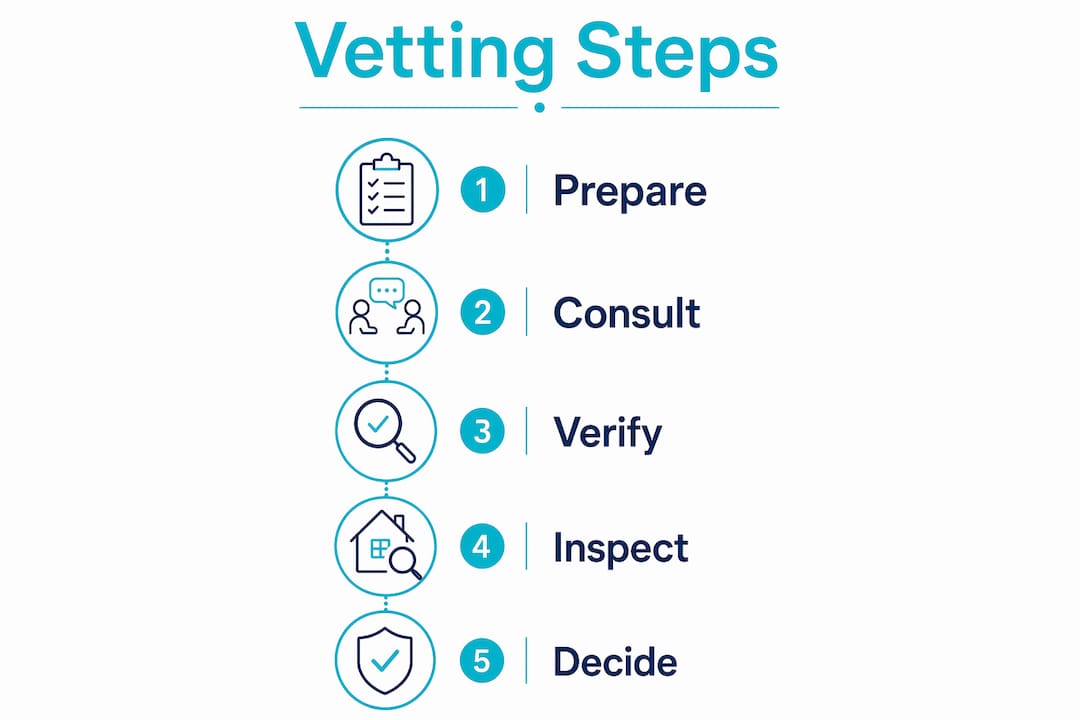
What are the practical steps to conduct a thorough vetting consultation?
A structured consultation is your best tool for separating qualified blind installation experts from contractors who are simply available. Preparation before the meeting makes the difference between a productive conversation and a wasted hour.
Build your checklist before the first call
Write down your window count, treatment type, any motorization requirements, and your timeline. This gives the contractor enough context to give you a meaningful response rather than a generic quote. A contractor who asks follow-up questions about your home’s construction and light needs is already demonstrating the right instincts.
Questions to ask during the consultation
Question | What a good answer looks like |
Are your installers direct employees or subcontractors? | Direct employees with verifiable training records |
Can you provide CHAS or equivalent accreditation? | Yes, with documentation available on request |
How do you handle measurement errors after installation? | Clear warranty or correction policy, in writing |
What child safety standards do you follow? | Named regulation or standard, not a vague assurance |
Do you offer aftercare or repair services? | Yes, with a defined process and contact point |
What to observe during the site visit
Watch how the contractor moves through your space. Contractors with proper safety procedures use correct equipment, protect your floors and furniture, and minimize hazards during the visit itself. A contractor who is careless during a consultation will be careless during installation.
Note whether they measure every window individually or use a single measurement for similar windows.
Check if they document their findings in writing or rely on memory.
Observe whether they explain their process or simply tell you what they plan to do.
The custom blinds installation checklist from Brandywineblinds covers the full sequence of steps homeowners should track from first contact through final installation. Using a structured checklist keeps you in control of the process and gives you a clear record if disputes arise later.
Common pitfalls when hiring blind installers
The most costly mistakes in hiring blind contractors happen before the first screw goes into the wall. Recognizing the warning signs early saves you money, time, and frustration.
Accepting digital badges as proof of quality. No blinds company qualifies for Google Guaranteed status, making that badge irrelevant in the blinds industry. Homeowners who rely on it are making decisions based on a credential that does not apply.
Skipping the insurance check. A contractor without current public liability insurance leaves you financially exposed if anything goes wrong on your property.
Ignoring who handles motorized components. Motorized blinds involve electrical wiring. If the contractor cannot clearly explain who is responsible for that work and what qualifications they hold, the liability is unclear.
Choosing based on price alone. The lowest quote rarely accounts for the full scope of a quality installation. Ask what the quote includes and what it excludes before comparing numbers.
Overlooking aftercare. Reliable blind installers provide aftercare and repair options as a standard part of their service. A contractor who disappears after installation day is not a professional partner.
Choosing a blind installer based on price or review count without verifying credentials, insurance, and safety compliance is the fastest way to end up with a poor installation and no recourse. The contractors who invest in accreditation, in-house teams, and documented processes are the ones who stand behind their work.
The best local blind services are transparent about their limitations. A contractor who tells you what they cannot do is more trustworthy than one who promises everything.
Key Takeaways
Reliable blind installation depends on verifying credentials, safety compliance, and consultation quality before any work begins.
Point | Details |
Credentials over badges | CHAS accreditation and BBSA membership outweigh digital badges like Google Guaranteed. |
In-house teams matter | Direct employees provide better oversight and faster issue resolution than subcontractors. |
Consultation reveals expertise | Process-based questions during the site visit expose technical depth that reviews cannot. |
Aftercare signals professionalism | Contractors who offer repair and aftercare services demonstrate long-term accountability. |
Homeowner involvement improves outcomes | Active participation in measurement and product selection reduces errors and mismatches. |
Why I think most homeowners vet contractors too late
Most homeowners start asking the hard questions after something has already gone wrong. I have seen it repeatedly: a contractor finishes the job, the blinds are crooked or the motorization fails, and the homeowner discovers there is no warranty, no in-house team to call back, and no documentation to support a complaint.
The contractors I trust most are the ones who make vetting easy. They hand over their CHAS certificate before you ask. They introduce you to the specific installer who will be in your home. They walk through the site and flag potential problems before they quote. That level of transparency is not common, and when you find it, it is worth paying for.
Homeowner accountability also plays a bigger role than most people expect. When you stay involved throughout the consultation and installation process, you catch measurement discrepancies early, confirm product choices match your actual windows, and create a shared record of decisions. Contractors respond to engaged homeowners with more care and precision.
The uncomfortable truth about contractor reviews for blinds is that most of them measure satisfaction, not quality. A homeowner who does not know what a correct installation looks like will leave a five-star review for a mediocre job. The only way to cut through that noise is to ask technical questions, check credentials, and observe behavior during the consultation. That is where the real signal lives.
— Dave
Brandywineblinds: local expertise you can verify
Brandywineblinds has spent over 30 years installing custom window treatments across Chester County and the surrounding area. Every installation is handled by local experts, not subcontractors, and every client receives a lifetime service warranty that covers the work long after installation day.
Brandywineblinds eliminates the corporate overhead that inflates prices at big box stores, which means homeowners typically pay significantly less for a higher standard of service. The team guides you through the full range of options, from vertical blinds to cellular shades and plantation shutters, with a consultation process built around your specific windows and home. If you want to see the quality of recent work before committing, the recent projects gallery shows real installations across a range of home styles. Request a consultation and experience what a properly vetted local installer actually looks like.
FAQ
What does vetting a blind contractor actually involve?
Vetting means verifying a contractor’s credentials, insurance, safety documentation, and local references before hiring. It goes beyond reading online reviews to include direct questions about their installation process and team structure.
Is CHAS accreditation required for blind installers?
CHAS accreditation is not legally required, but it is a strong indicator of professionalism. CHAS-accredited contractors maintain documented risk assessments and safe working practices that unaccredited contractors may lack.
How do I know if a contractor uses subcontractors?
Ask directly during the consultation. Professional installers who use direct employees will say so clearly and can describe their team’s training. Vague answers about “our installation partners” usually indicate subcontracting.
What questions should I ask about motorized blinds?
Ask who handles the electrical components, what qualifications they hold, and what happens if the motorization fails after installation. A qualified contractor will name the specific standard they follow and explain the warranty coverage for motorized systems.
Why do contractor reviews for blinds sometimes mislead homeowners?
Most reviews measure customer satisfaction rather than technical quality. A homeowner who cannot identify a poor installation will still leave a positive review. Complement review research with detailed consultation questions to get an accurate picture of a contractor’s real expertise.
Recommended
Comments