
Window Treatments for Odd Shaped Windows: 2026 Guide
- WINDOWCOVERINGWIZARD
- 1 day ago
- 9 min read

Window treatments for odd shaped windows are custom coverings designed to fit unique geometries like arches, angles, trapezoids, and skylights while meeting your specific needs for privacy, light control, and energy efficiency. Standard off-the-shelf blinds simply do not work for these windows. The right solution depends entirely on your window’s shape and what you need it to do every day. Cellular shades, plantation shutters, and custom drapery are the three most frequently recommended options for non-standard shapes, and each serves a different geometry and purpose. Getting the fit right also requires precise measuring and, in many cases, professional installation.
What are the best window treatments for odd shaped windows?
The honest answer is that no single treatment wins for every odd window. The right choice depends on your window’s geometry and your top priorities, whether that is privacy, glare reduction, or thermal performance. A triangular skylight in a vaulted ceiling calls for a completely different solution than a wide bay window in a living room.
Cellular shades are the most versatile starting point for unusual shapes. Their honeycomb construction traps air and improves insulation, which makes them especially useful for arched or angled windows that lose heat quickly. Custom drapery adds warmth and stylistic flexibility, particularly for bay windows where fabric can soften the angular geometry. Plantation shutters work well for arched, hexagonal, and octagonal windows because they can be built to follow the exact curve or angle of the frame.
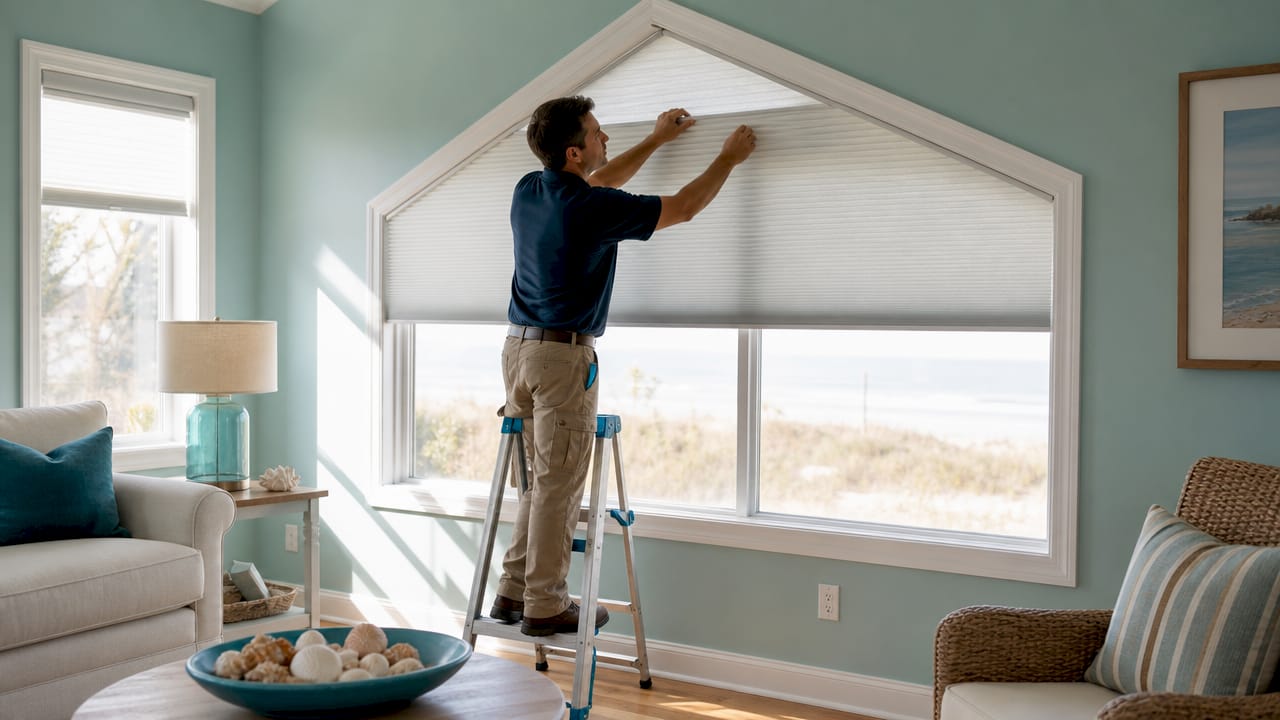
The key insight most homeowners miss is this: geometry drives the decision, not aesthetics. Pick the treatment type that physically fits your window first, then choose the color and material.
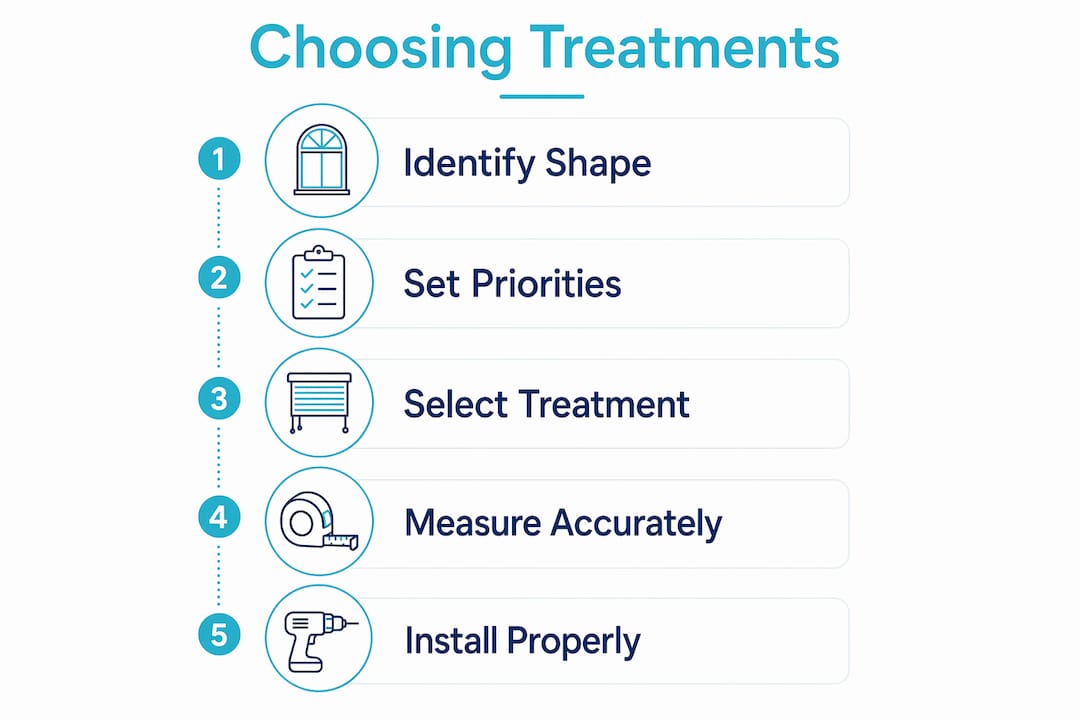
How to identify your window shape and set your priorities
Before you shop for any covering, you need to know exactly what type of window you have. Each shape creates different challenges for fit, light control, and daily use.
Common odd window shapes include:
Arched windows: Rounded tops that curve from one side to the other. The arch portion is often fixed while the lower rectangular section is operable.
Angled or triangular windows: Found in A-frame homes, gable ends, and stairwells. These require treatments cut to a precise angle.
Trapezoid windows: Wider at the bottom than the top, or vice versa. Common in contemporary architecture.
Bay windows: Three or more panels that project outward from the wall. Each panel may need its own treatment.
Skylights: Mounted in the ceiling or on a steep pitch. Hard to reach and prone to glare and heat gain.
Hexagonal and octagonal windows: Decorative shapes often found in bathrooms or as accent windows.
Once you know your shape, clarify what you need the treatment to do. Privacy matters most in bathrooms and ground-floor bedrooms. Glare control is the priority for home offices and media rooms. Energy efficiency becomes critical for skylights and south-facing arched windows that absorb direct sun all day. For windows that are high up or hard to reach, daily usability should rank above everything else.
Pro Tip: Write down your top two priorities before you look at any product. Homeowners who skip this step often buy a treatment that looks great but fails in daily use.
Best treatment options for different odd-shaped windows
Matching the right product to your window shape is the most important decision you will make. Here is how the main options break down by window type.
Cellular shades for arches, trapezoids, and angles. Cellular shades can be fabricated to fit nearly any shape. Their single-cell or double-cell construction provides insulation, and they mount cleanly inside or outside the frame. For arched windows, the standard approach is to pair a fixed shade in the arch area with an operable shade below. The fixed upper section handles the curve without requiring complex mechanisms, while the lower shade gives you daily light and privacy control. This split-zone method reduces light gaps and avoids engineering challenges that come with fully operable curved systems.
Custom drapery for bay windows and large angles. Floor-to-ceiling drapery panels work well for bay windows because they can be hung on a curved or angled rod that follows the window’s projection. Fabric softens the geometry and adds insulation through layering. A 2026 guide recommends fabric layering for warmth in rooms where cellular shades alone feel too minimal.
Plantation shutters for arched and geometric windows. Plantation shutters are built to order and can follow the exact curve of an arch or the precise angles of a hexagon. They provide strong light control through adjustable louvers and are one of the most durable options available. Brandywineblinds offers plantation shutters fabricated for specialty shapes, including full-arch and eyebrow windows.
Fixed vs. operable treatments. Fixed panels work best for high angled windows where glare control matters more than daily adjustment. Operable treatments are worth the added cost for any window you interact with regularly, such as a bedroom arch or a living room bay.
Motorized treatments for high or hard-to-reach windows. Motorized blinds are the preferred solution for apex windows, gable glazing, and stairwell windows where manual operation is impractical. A remote or smart home integration lets you adjust coverage without a ladder. Technical advances in rail and track systems now allow custom blinds to fit tiny, angled, or diamond-shaped windows that were previously considered untreatable.
Pro Tip: For skylights, always choose a motorized cellular shade with a blackout or room-darkening fabric. Skylights receive direct overhead sun and can raise room temperature significantly without proper coverage.
How to measure and mount treatments for odd-shaped windows
Accurate measuring is where most DIY projects fail. Odd-shaped windows require a different approach than standard rectangles.
Window type | Key measurement points | Mount recommendation |
Arched window | Base width, rectangle height, arch peak height | Inside mount preserves the arch curve |
Trapezoid | Width at top, width at bottom, height on each side | Outside mount for cleaner visual balance |
Triangle/angle | Width at base, height at tallest point, angle of slope | Custom fabrication required; template recommended |
Bay window | Each panel measured independently | Inside mount per panel for clean separation |
Skylight | Frame width and length, pitch angle | Outside mount with extended hardware |
For arched windows, inside mount measuring requires three numbers: the width at the base of the arch, the height of the rectangular section below the arch, and the total height from base to the top of the arch peak. Outside mount measuring covers a larger area and requires an additional allowance on all sides for visual balance and light blockage. Inside mounts preserve the natural arch curve and tend to look cleaner. Outside mounts work better when the arch is irregular or when you need maximum light blockage.
For triangular and deeply angled windows, a tape measure alone is not enough. Physical templates made from craft paper give fabricators the exact curve or angle they need. Trace the window opening directly onto the paper, cut it out, and send it with your order. This step eliminates the tolerance errors that cause poor fit and light gaps.
Mounting hardware also matters. Curved tension rods, specialty brackets, and angled mounting plates are all available for non-standard frames. Using the wrong hardware causes the treatment to sit unevenly, which creates light gaps at the edges and makes operation difficult.
Pro Tip: Measure every odd-shaped window at least twice, and measure at multiple points across the width and height. Window frames in older homes are rarely perfectly square, even when they look it.
Installation mistakes that ruin custom window treatments
Custom treatments are only as good as their installation. Even a perfectly fabricated shade fails if it is mounted incorrectly.
The most common mistakes homeowners make include:
Skipping professional measurement. Custom cellular shades, draperies, and shutters are built to the dimensions you provide. An error of even a quarter inch can cause light leakage or prevent the treatment from operating smoothly.
Choosing standard hardware for curved frames. Flat brackets do not seat properly on curved or angled frames. This creates wobble, uneven hang, and gaps at the edges.
Ignoring cord and chain safety. Cordless and motorized systems are the safer and more practical choice for any window that children or pets can reach. They also simplify daily use on windows that are awkward to access.
Underestimating maintenance needs. Custom treatments last 10–15 years with proper care. Periodic vacuuming with a brush attachment keeps fabric shades clean. Avoid laundering or dry cleaning most custom shades, as this can distort the shape.
Treating cost as the only variable. Custom window coverings for specialty shapes typically represent a meaningful investment. The value comes from durability, exact fit, and the energy savings that a well-fitted cellular shade provides over time. A treatment that fits poorly costs more in the long run because it needs to be replaced sooner.
Working with a local specialist who measures in person removes most of these risks. Brandywineblinds provides professional measuring and installation for specialty shapes, which means the fit is guaranteed before fabrication begins.
Key Takeaways
The most effective window treatments for odd shaped windows match the treatment type to the window’s exact geometry before any other consideration.
Point | Details |
Geometry drives the choice | Identify your window shape first, then select a treatment type that physically fits it. |
Split-zone arched windows | Use a fixed shade in the arch and an operable shade below to simplify fit and daily use. |
Templates beat tape measures | Trace irregular curves onto craft paper and send the template to your fabricator for exact fit. |
Motorize hard-to-reach windows | Motorized systems are the practical standard for skylights, apex windows, and stairwell glazing. |
Professional installation protects your investment | Custom treatments last 10–15 years with correct installation and basic maintenance. |
What I’ve learned after years of odd-shaped window projects
Most homeowners come to me focused on what a treatment looks like. That is understandable. But after working with hundreds of specialty window projects, I can tell you that the treatments that cause the most regret are the ones chosen for looks first and fit second.
The split-zone approach for arched windows is a perfect example. Homeowners often want a single, fully operable curved shade because it looks cleaner in photos. In practice, fully operable curved mechanisms are expensive, prone to operational issues, and harder to service. A fixed arch panel paired with a clean cellular shade below looks just as good and works reliably every day.
I also see homeowners underestimate motorization. If your window is above shoulder height, manual operation becomes a chore within a week. Motorized shades for high windows are not a luxury. They are the difference between a treatment you actually use and one you leave closed permanently. The value of motorized shades becomes obvious the first time you adjust your skylights from your phone on a hot afternoon.
One more thing: do not skip the template step for truly irregular shapes. I have seen beautiful custom shutters arrive that fit three sides of a window perfectly and gap on the fourth because the frame had a subtle warp no tape measure caught. A paper template costs nothing and prevents an expensive remake.
— Dave
Custom window treatment solutions from Brandywineblinds
Odd-shaped windows deserve treatments that are built for them, not adapted from standard sizes. Brandywineblinds has over 30 years of experience fitting specialty shapes including arches, trapezoids, hexagons, and skylights across Chester County and the surrounding area.
Their product range covers cellular shades for insulation and exact fit, plantation shutters for arched and geometric windows, and light control shades for rooms where glare and privacy are the top concerns. Every project includes in-home measuring by a local expert and a lifetime service warranty. Brandywineblinds prices run up to 30% lower than big-box retailers because there is no franchise overhead built into the cost. Schedule a free in-home consultation to get accurate measurements and a treatment recommendation matched to your specific window shapes.
FAQ
What window treatment works best for arched windows?
Cellular shades with a fixed panel in the arch and an operable shade below are the most practical solution. This split-zone approach handles the curve without complex mechanisms and gives you daily light control in the lower section.
Can I use standard blinds on odd-shaped windows?
Standard blinds are made for rectangular windows and will not fit arches, triangles, or trapezoids correctly. Custom-fabricated treatments are required to prevent light gaps and operational problems.
How do I measure a triangular or angled window?
Measure the base width, the height at the tallest point, and the angle of the slope. For irregular curves, trace the window opening onto craft paper and use that template for fabrication rather than relying on tape measure dimensions alone.
Are motorized treatments worth it for hard-to-reach windows?
Motorized treatments are the standard recommendation for skylights, apex windows, and stairwell glazing. Manual operation of high windows is impractical daily, and motorized systems integrate with smart home platforms for added convenience.
How long do custom window treatments last?
Custom treatments last 10–15 years with proper care. Periodic vacuuming with a brush attachment keeps fabric shades in good condition. Avoid laundering or dry cleaning, which can distort custom shapes.
Recommended
Comments